
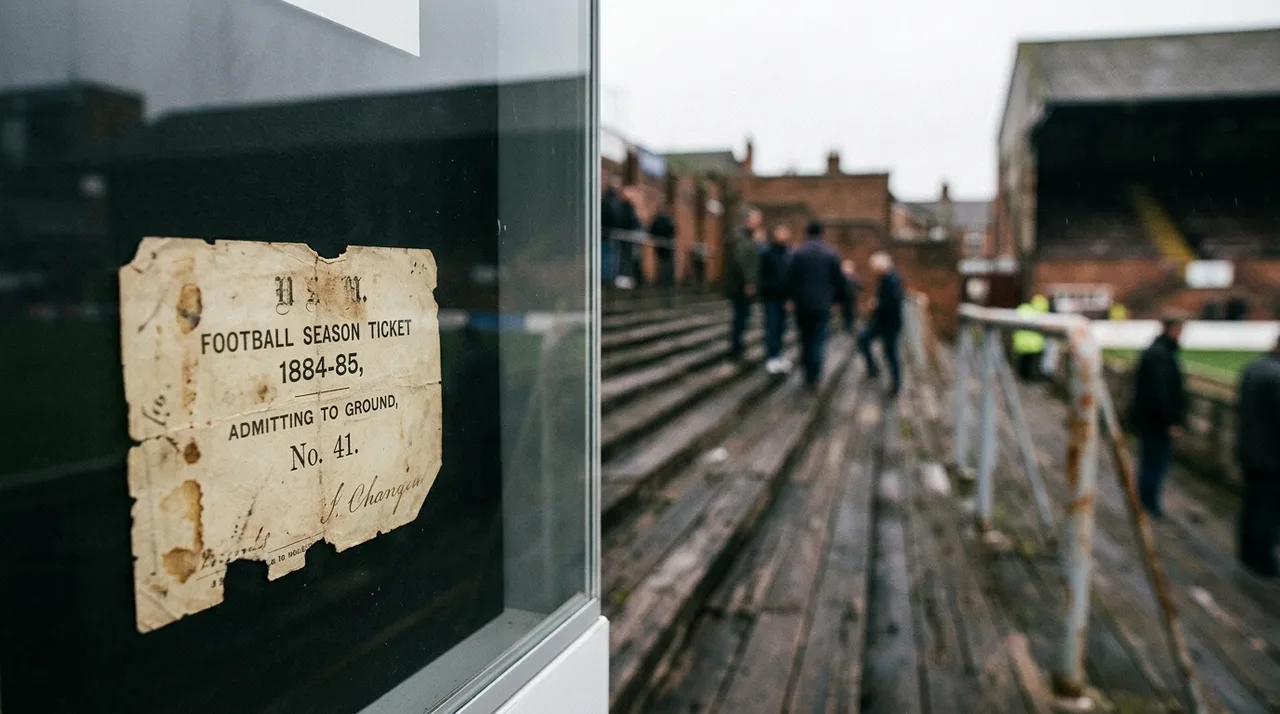
The oldest football season ticket in the world belongs to Burnley. Preserved at Turf Moor, the document dates to the 1884-85 season, predating the Football League by four years. Its wording is blunt: "This card is not transferable. Any member violating this rule will be at once expelled from the club." One hundred and forty-two years later, that tension between club authority and supporter entitlement has never felt more raw.
A relic that tells a modern story
The Burnley artefact has been cited recently in a broader national discussion about what season tickets actually mean, and who clubs believe they are for. While the Clarets' 1884 ticket sits behind glass as a curiosity, the principles it embodies, loyalty, exclusivity, the bond between a town and its football club, are being tested at grounds up and down the country.
The Football Supporters' Association has put the argument plainly. Clubs, particularly the wealthiest ones, are increasingly seen by supporter groups as preferring stadiums full of one-off visitors over long-standing season-ticket holders. The FSA's reasoning is straightforward: the occasional fan spends more on matchday. They fill the club shop, pay a premium for their seat, and carry none of the sense of entitlement that a supporter who has held the same seat for twenty years might reasonably feel. "It's a shortsighted vision," the FSA has said, though it is a vision that appears to be spreading.
For Burnley supporters, the context is specific. The Clarets are a Championship club this season, playing in the second tier in front of crowds at Turf Moor that reflect a genuine, working community fanbase. Season-ticket revenue matters here in a way that is qualitatively different from the calculation at a club sitting on a nine-figure broadcast rights deal. At this level, a supporter who commits to a full season is not a discounted liability; they are the financial backbone of the operation.
What the economics look like lower down
Sports economics academics have noted that season tickets "come at a cost" for clubs where demand significantly outstrips seat supply. The argument holds in the Premier League, where sell-out stadiums are the norm and clubs can, in theory, replace every season-ticket holder with a higher-paying customer without leaving a seat empty. It does not translate cleanly to the Championship, where attendances matter to the profit-and-loss account and pricing strategies have to weigh community affordability against commercial returns.
Burnley averaged over 17,000 for home Championship fixtures in recent second-tier campaigns. That kind of support, drawn from east Lancashire towns where disposable income is not unlimited, depends on season tickets being priced accessibly and on clubs treating holders as partners rather than problems. The 1884 ticket's warning about transferability notwithstanding, the implicit deal in the modern era has always been that commitment is rewarded with continuity.
A wider warning worth heeding
The fact that the Burnley artefact has been drawn into a conversation dominated by Premier League clubs is, in its way, instructive. It illustrates how the values that built English football, rooted in local identity and seasonal commitment, are being quietly renegotiated at the top of the game, with consequences that filter downwards through the divisions.
Championship clubs are not immune to those pressures. Hospitality expansion, variable pricing, and the growth of secondary ticketing markets are not exclusively Premier League phenomena. The difference, for now, is that a club like Burnley cannot afford to treat its season-ticket holders as an inconvenient legacy. The town has a stake in this club that no balance sheet fully captures, and the oldest ticket in the world, kept carefully at Turf Moor, is as good a reminder of that as any.
Whether the current generation of executives at any level of the game feels the weight of that history is, of course, a different question entirely.
Frequently asked
- Where is the world's oldest football season ticket kept?
- The oldest known football season ticket, dating to Burnley's 1884-85 season, is preserved at Turf Moor in Burnley.
- Are Burnley in the Championship this season?
- Yes, Burnley are playing in the Championship, the second tier of English football, this season.
- What are season-ticket holders worried about at football clubs?
- Many supporters fear that clubs, driven by commercial pressures, increasingly prefer one-off visitors over loyal season-ticket holders, who tend to spend less per visit than occasional fans.