
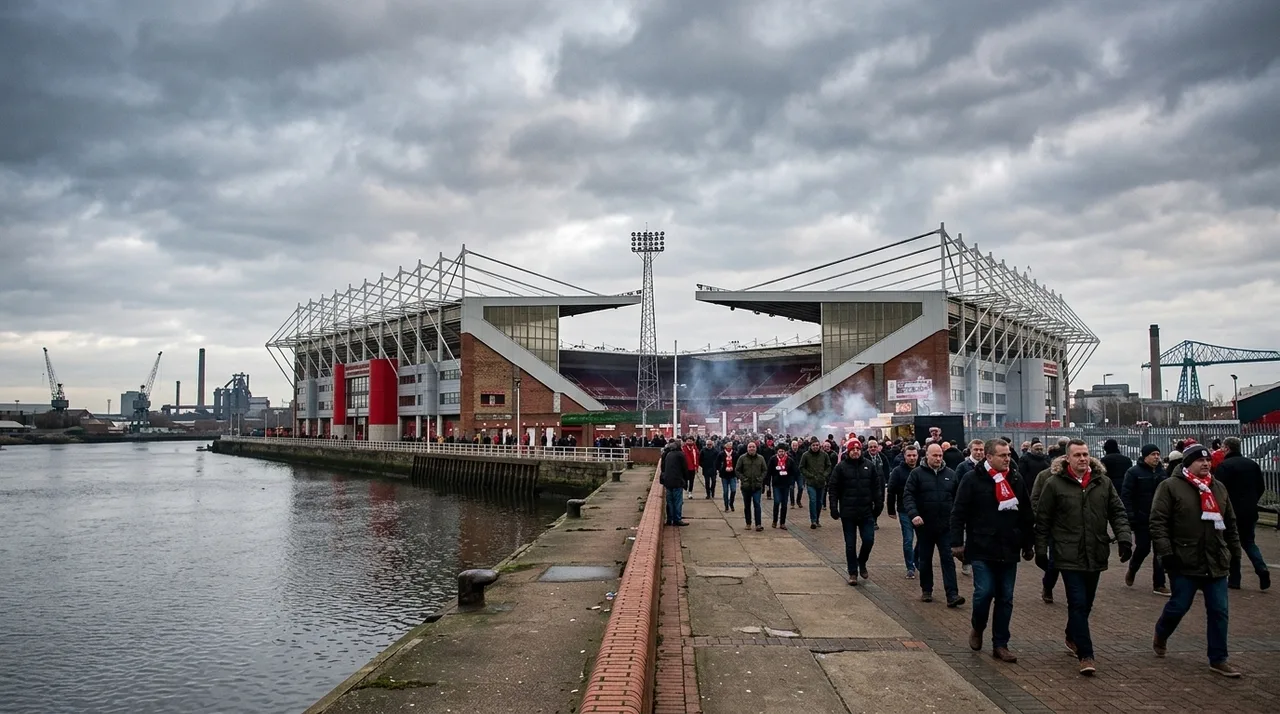
Middlesbrough's Riverside Stadium has been held up as an example of how English football clubs can keep the memory of industrial communities alive, following research presented at an international conference in Gijón, Spain.
Dr Tosh Warwick, a research associate at the University of Sheffield, gave a talk titled Football and industrial heritage in the North East of England at the INCUNA International Conference on Industrial Heritage. The presentation drew on the connections between Teesside's manufacturing past and the Riverside Stadium, which has stood as Middlesbrough's home since 1995.
A stadium rooted in the region's identity
Warwick's central argument is straightforward: football grounds in the North East sit on land, and within communities, shaped by heavy industry. The Riverside was built in a post-industrial dockland area of Teesside, a region whose identity was defined for generations by steel, shipbuilding and chemical manufacturing. The club, Warwick argued, carries a responsibility and an opportunity to reflect that history back to its supporters and to wider audiences.
"Profiling and articulating our industrial heritage at football stadiums and matches helps share the region's industrial history and culture with new audiences," Warwick said. "This in turn can help promote the area, encourage wider awareness of the opportunities of the region."
The research covered both Middlesbrough and Sunderland, whose Stadium of Light was built directly on the site of the former Wearmouth Colliery. Sunderland's ground incorporates mining heritage explicitly: the name itself is a reference to the lamp used by pit workers, and a giant Davy Lamp sculpture stands outside. The contrast with the Riverside is instructive. Middlesbrough's stadium does not sit on a former colliery, but the surrounding area's steel and dockland history is no less present in the community that fills the ground on match days.
More than heritage tourism
Warwick was careful to frame this not as nostalgia or window-dressing but as something with practical cultural and economic value. He said he hoped the research would encourage clubs and institutions to make greater use of industrial heritage, pointing to the "cultural and economic benefits" of doing so.
"The role of the beautiful game is bringing the manufacturing past into the present," he said.
That is a claim worth taking seriously in the context of Teesside specifically. The region has faced well-documented economic challenges since the contraction of its traditional industries, and football clubs, as among the most visible and emotionally significant institutions in post-industrial towns, occupy a particular place in how those communities understand themselves.
For Middlesbrough supporters, the club's identity has long been bound up with a sense of the town it represents: working class, proud, occasionally overlooked. That Warwick's research was presented at an international conference on industrial heritage suggests this is a connection now being examined seriously in academic circles, not just felt instinctively on the terraces.
What it means for Middlesbrough
The Riverside holds just over 33,700, and attendances this Championship season have reflected the genuine attachment supporters have to the club. Warwick's research, presented to an international audience, makes the case that this attachment is not incidental: it is partly a product of the industrial history the club embodies, whether or not that heritage is explicitly marked in the stadium's fabric.
There is no suggestion of any specific club initiative tied to this research, and it would be press-release language to imply one is imminent. But Warwick's work does raise a legitimate question for Middlesbrough as an institution: how deliberately, and how visibly, does the club engage with the Teesside story that gives it so much of its meaning?
It is the kind of question that tends to get answered in the details: a mural here, a community project there, or simply the decision about what stories a club chooses to tell about itself. For a Championship club embedded in one of England's most distinct industrial regions, the raw material is there.
Frequently asked
- When was the Riverside Stadium built?
- The Riverside Stadium opened in 1995 on a post-industrial dockland site in Teesside, replacing Middlesbrough's former ground at Ayresome Park.
- What is Middlesbrough's connection to industrial heritage?
- Middlesbrough's identity as a club is closely linked to Teesside's history of steel, shipbuilding and chemical manufacturing. Research presented at the INCUNA conference in Spain explored how the Riverside Stadium and the club can help preserve and share that history with new audiences.
- What capacity is the Riverside Stadium?
- The Riverside Stadium has a capacity of just over 33,700, making it one of the larger grounds in the Championship.