
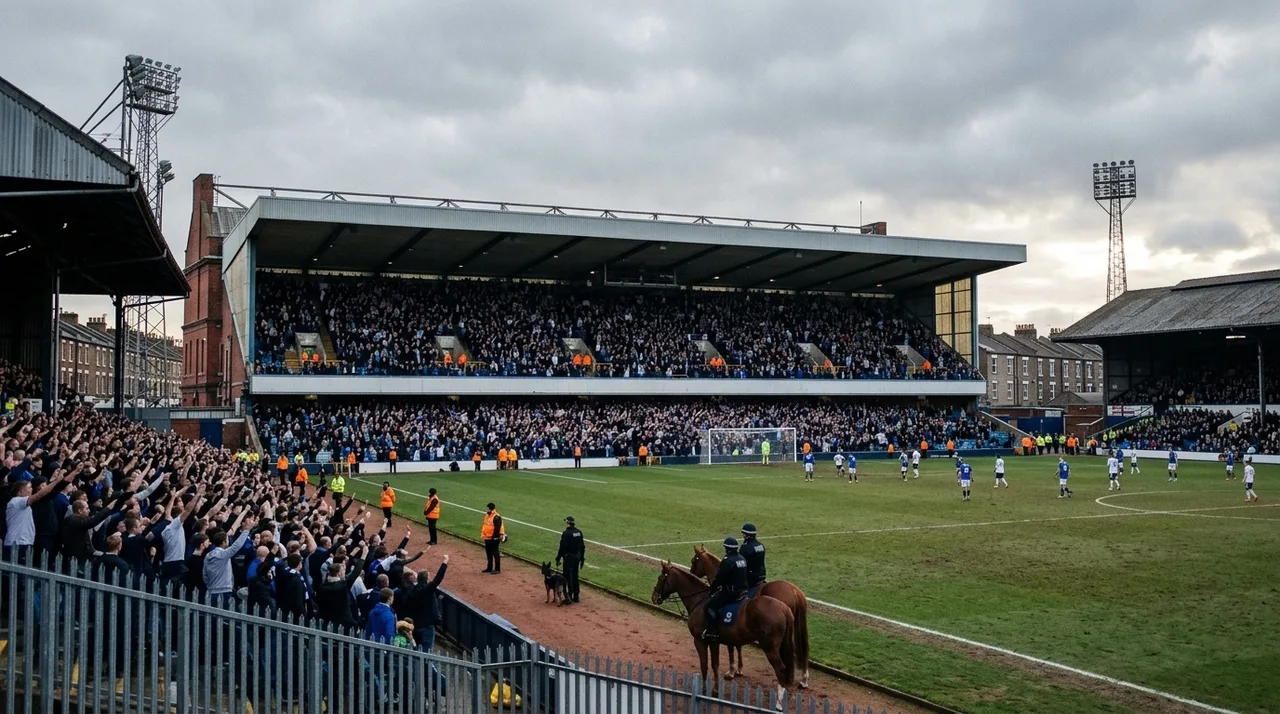
When Millwall hosted West Ham at the Den on 19 September 2026, it was a fixture 14 years in the making and, by the clubs' combined reckoning, the 100th competitive meeting between them. Documentary photographer Adam Isfendiyar was in south-east London to capture the matchday, and the images that have emerged tell a story that stretches well beyond 90 minutes of Championship football.
Two clubs, one river, shared roots
The geography matters. Before Millwall relocated south of the Thames to New Cross in 1910, both clubs existed north of the river, separated by barely two miles. Millwall, then known as the Dockers, were based on the Isle of Dogs. West Ham grew out of the Thames Ironworks and Shipbuilding Company, around Canning Town. The Irons nickname that West Ham still carry is a direct reference to those origins. Dock work was precarious: men gathered each morning with no guarantee of being selected for a day's labour, and that culture of physical toughness, loyalty and fierce local pride shaped the character that both clubs still invoke in their own self-presentation.
The clubs' histories first overlapped in the 1890s, when Millwall Athletic played Thames Ironworks. Historians David Sullivan and Brian Belton caution, however, against treating Thames Ironworks FC as a straightforward predecessor of West Ham United. The company team was dissolved before the new club was formally constituted in 1900, and Belton is sceptical of the idea of a centuries-old Dockers Derby at all.
Mythology and the making of a rivalry
One story placed at the origin of the hostility is the General Strike of 1926. The tale holds that West Ham dock workers supported the strike while Millwall workers did not, planting a seed of bitterness that eventually flowered into football enmity. Sullivan and Belton dispute this version directly. Belton argues that the strike was solid in the Millwall docks, while it was around Canning Town, West Ham's territory, where a handful of workers broke ranks. The story has nevertheless survived for a century and become embedded in the mythology of the fixture, a reminder that a rivalry's folklore and its history are rarely the same thing.
The real intensification of hostility, both historians suggest, came much later, particularly during the 1970s. There was serious disorder at Harry Cripps's testimonial in 1972, a match intended to honour a player well-regarded at both clubs. In 1976, a Millwall supporter died after falling from a train, with suspicion falling on West Ham fans. When the clubs met competitively again in 1978 after a long absence, violence accompanied the occasion.
Industrial decline and a fixture's darkest years
It is difficult to ignore the timing. London's docks were closing through the late 1970s and 1980s. Traditional industries were shedding tens of thousands of jobs. Communities built around those industries were experiencing unemployment and economic decline on a scale that reshaped entire neighbourhoods. Belton and Sullivan stop short of drawing a direct causal line between industrial collapse and football disorder, and rightly so; the relationship is more complex than that. But the two processes ran concurrently, and football offered a territory, both literal and symbolic, in which local identity, masculinity and belonging could still be asserted when many of the institutions that had previously provided those things were gone.
The reputation of the fixture was periodically reinforced through the 1980s, 1990s and early 2000s. The most notorious flashpoint came at Upton Park in 2009, when a League Cup tie was marred by fighting outside the stadium, a stabbing and pitch invasions. That evening cast a long shadow.
Mounted police and a milestone match
Fourteen years on, the Den on 19 September was a heavily policed environment. Mounted officers worked the car parks. A Millwall supporter shouted towards the West Ham team bus as it arrived. West Ham fans were separated from home supporters by barriers and a visible police presence. The precautions were a reminder that the fixture still carries weight, in the community and in terms of public order planning.
Whatever the result, the occasion was significant for both sets of supporters. A century of competitive meetings between two Championship clubs bound by geography, industry and a history that is still being written and argued over is not nothing. The Den provided the setting; the docklands provided the story.
Frequently asked
- When did Millwall last play West Ham before the 2026 match?
- The two clubs had not met competitively for 14 years before their Championship fixture at the Den on 19 September 2026.
- Why is the Millwall vs West Ham fixture called the Dockers Derby?
- Both clubs were formed out of the dock and heavy industry communities of east London in the late 19th century. Millwall were known as the Dockers in their early years, while West Ham's nickname, the Irons, references their origins at the Thames Ironworks and Shipbuilding Company.
- How many times have Millwall and West Ham played each other?
- Their fixture on 19 September 2026 was the 100th competitive meeting between the two clubs.